4 min read
What a Claude Max Window Is Worth in API Dollars
On Max 5x, a 5-hour window held about $155 of API-equivalent usage and a week about $2,000. Six months of my Claude Code logs came to $35,757 at API prices, for about £700 in fees. What fills a window is context, not output.
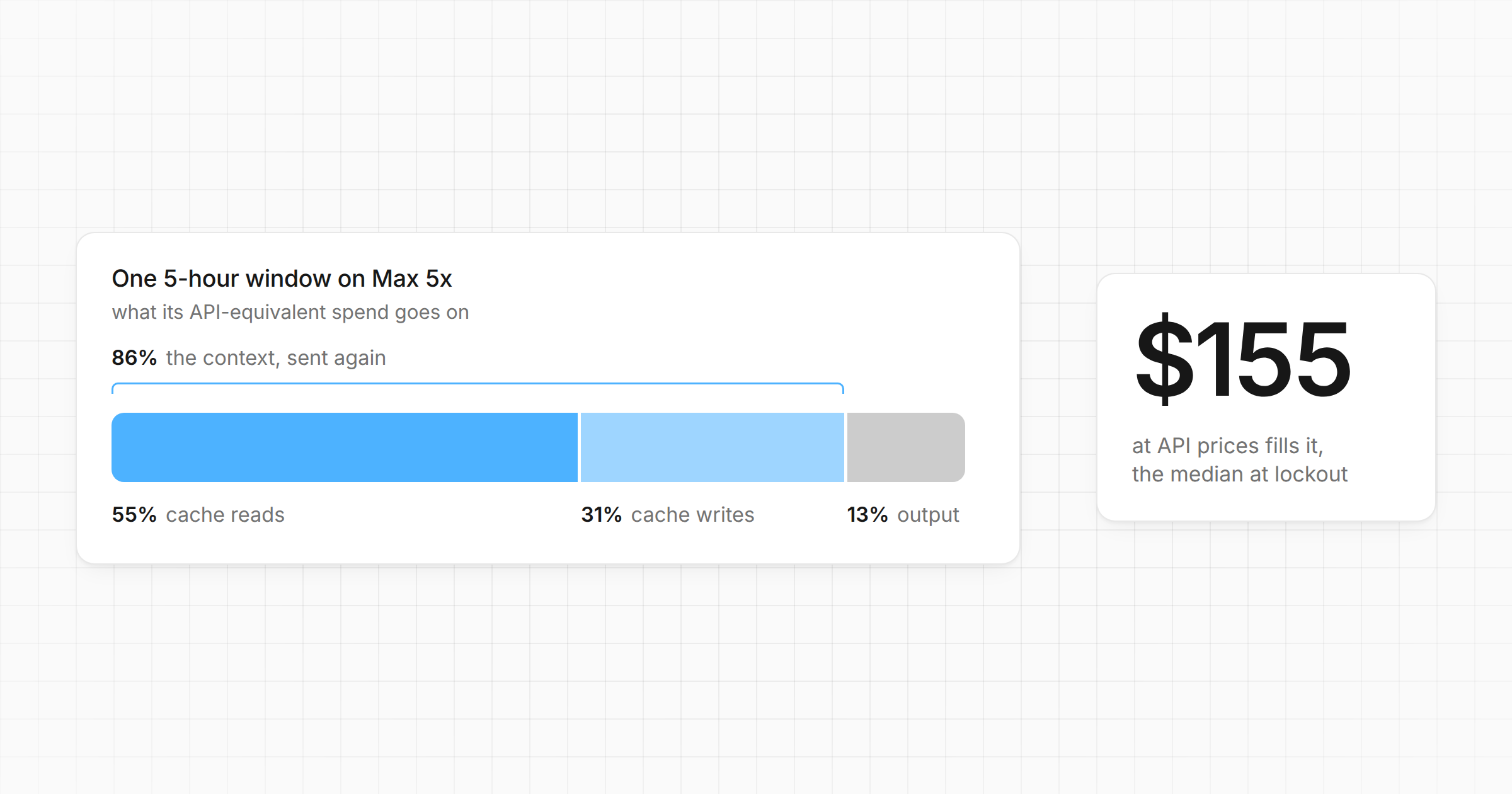
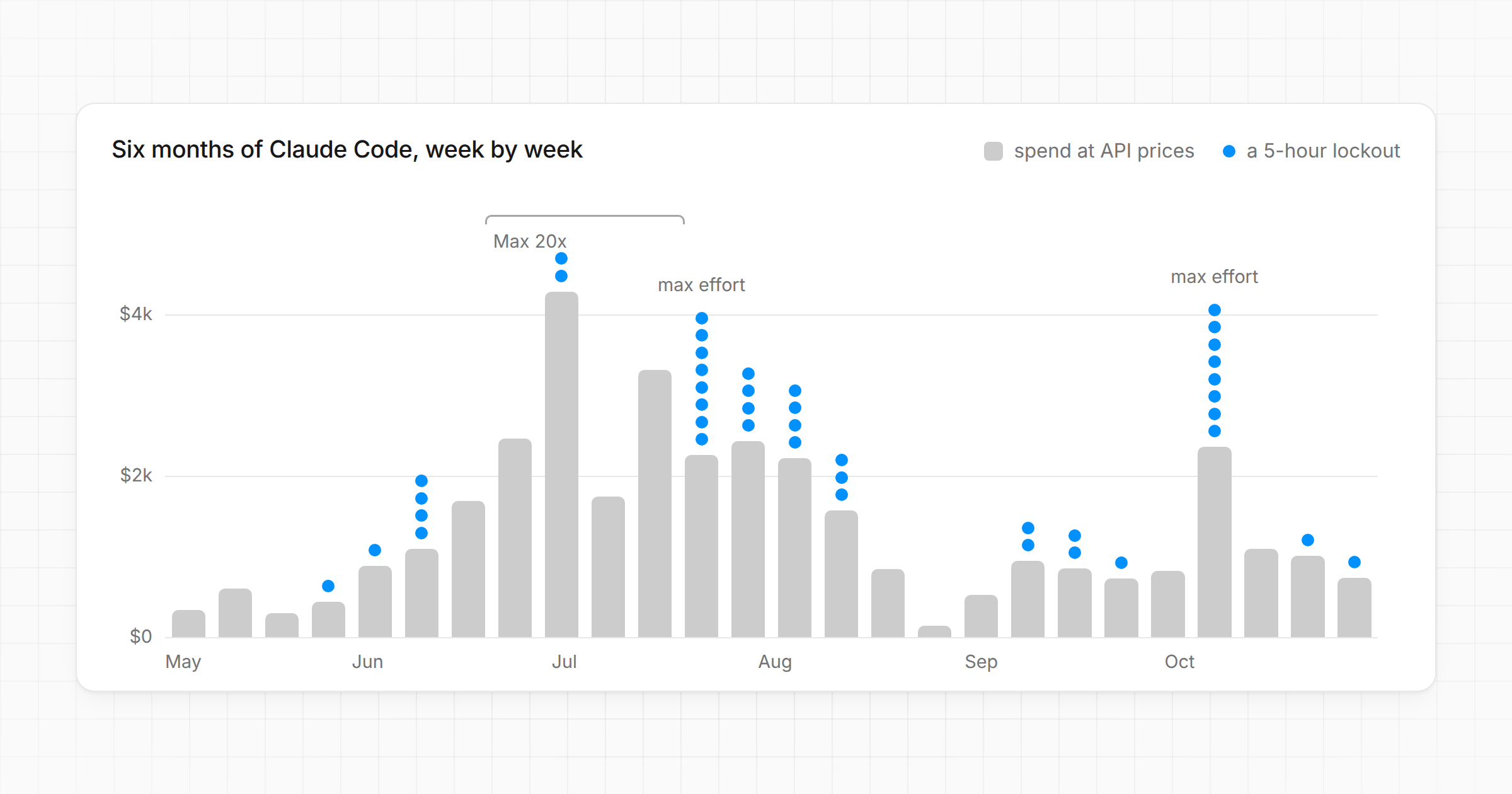
On Claude Max 5x, a 5-hour window holds about $155 of API-equivalent usage, and a week about $2,000. Claude Code only shows the limits as percentages, so I priced six months of my own logs at API rates and looked at what came before each lockout. The six months came to $35,757, for about £700 in subscription fees.
What a window holds
I was on Max 5x, except for one month on Max 20x. On 5x, the 5-hour limit locked me out 40 times and the weekly limit 4 times.
- The 5-hour window: the lockouts came at a median of $155 of usage in the 5 hours before. The range is wide, from $65 to $385, because my logs miss claude.ai and my phone, which draw on the same limits, and because a lockout soon after another shares part of the same 5 hours.
- The week: three of the four weekly lockouts came after $2.0–2.5k in 7 days, and one after $1.2k.
- Max 20x: my only two lockouts came at $605 and $760, four to five times the 5x figure. Two are too few for a median.
- The meter counts money, not tokens. Fable costs more than two and a half times as much as Opus 5.5 for the same tokens, yet a window spent entirely on Fable locked at $151, close to the median. A meter that counted tokens would have let that window run far past $151.
My average week on 5x was $1,089, about half the weekly limit, so the 5-hour window was the one that locked me out, ten times as often.
Has Anthropic cut the limits? Not that I can see. The median spend before a 5x lockout was $95 in May and June, $123 in late July, $175 in August, $120 in September and $169 in October, and the weekly lockouts came at much the same $2.0–2.5k in August and October. With 5 to 11 lockouts a month, a cut smaller than about a third wouldn’t show, and a month where I used Claude more on other devices would look lower than it was.
What fills it
Of the $35,757, 55% went on cache reads, 31% on cache writes and only 13% on output. Every request sends the whole conversation again, and one prompt I type sets off about 10 requests, one per tool call. At a median context of 174k tokens, I mostly paid to send the conversation again and again, not for Claude’s answers. Four-fifths of the money went on requests above 100k tokens of context.
So what costs is context, and four things grew it more than I expected:
- Sessions left open. Sessions that stayed open more than 24 hours were 189 of my 2,542, but 42% of the spend. A session carries everything it has done into every later request.
- Coming back after an hour. Claude Code’s cache lasts an hour, and writing to it costs 40 times as much as reading from it ($8 against $0.20 per million tokens on Opus 5.5). After an hour away, the next prompt writes the whole context again. I did that 1,654 times, for 10% of the spend. Compacting before I walk away makes that rewrite smaller.
- Max effort. Its extra output is small, but its thinking stays in the context: on Opus 5.5, a session at max grew 2,917 tokens per request against 1,534 at high, so it fills up twice as fast. It caused two runs of lockouts: 11 in a week in late July and 8 in four days in early October, with 73–100% of the spend in each window at max or xhigh effort.
- Running sessions side by side. Each one draws on the same window. 14 main sessions ran in the 5 hours before my lockout on 19 October, and 28 before the one on the 26th.
Two things mattered less than I thought. Switching to Sonnet barely saves on context: in Claude Code’s own cost records, its cache reads cost about the same as Opus 5.5’s ($0.19 against $0.20 per million), so the saving is on output, 13% of the spend. And subagents were only 13% of the spend. My start-up config, sent again with every request, came to about 8% by my estimate. What My Coding Agent Config Costs on Every Call measures what it adds to each task.
Check your own
ccusage reads Claude Code’s local transcripts and prices them at API rates:
npx ccusage claude monthly   # API-equivalent cost by month
npx ccusage claude blocks    # by 5-hour block
Its blocks are its own grouping and may not line up with your plan’s windows. To see what your window holds, take a time you were locked out and add up the 5 hours before it.
For the lockouts I wrote my own scan of the transcripts on both my computers, 240,000 requests, priced at Claude Code’s own rates, which match the cost records it keeps for Opus and Fable. On my main computer it comes within 1% of ccusage. My second computer’s logs only go back to 30 September: Claude Code deletes local transcripts after 30 days unless you raise cleanupPeriodDays in its settings, so raise it now if you want the history later. Usage on claude.ai or a phone counts toward the same limits and isn’t in any of these logs, so treat my figures as a lower bound on what a window holds.
These numbers are why I built agent-usage-guard, a Claude Code mod that asks before more agents start, before heavy context and before retry loops burn the window. What Stops Claude Code Burning Your Usage Window compares it with the other tools. It doesn’t limit parallel sessions yet, and they’re what lock me out now.